Art as infrastructure: how Sidewalk Detroit reimagines stormwater through public sculpture
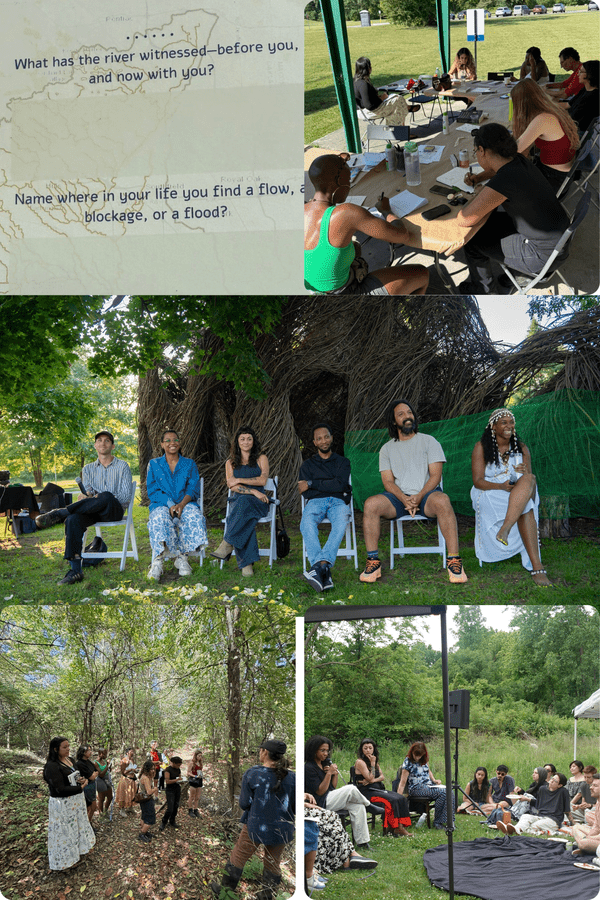
Collaged photo of the different workshops, programming, and celebrations featuring Sidewalk Detroit's Eco-Artist-in-Resident Maya Davis.
Top left: Writing prompts centered on storytelling, water, and our water relationships. Top right: Participants gather under a pavilion at Eliza Howell Park for a community writing workshop. Middle: Sidewalk Detroit Eco-Artist in Residence Maya Davis and Earth Future Fellows at Eliza Howell Park during Sidewalk Festival, from left to right: David McGuffie, Maya Davis, Cyrah Dardus, Marcus Elliot, Billy Mark, and Imani Ma’at, speaking about their work. Bottom left: Participants learn about the trees of Eliza Howell Park during a writing workshop led by Indigenous Anishinaabe artist Hadassah Greensky and naturalist Emily Brent. Bottom right: A panel discussion at Eliza Howell Park exploring the intersection of ecology, science, and art.
The rain-activated sculpture, located in one of Detroit’s largest city parks, is a powerful tool for climate justice.
Sidewalk Detroit’s Eco-Artist-in-Resident, Maya Davis, has been developing a permanent rain-catchment sculpture for Eliza Howell Park, to be installed in summer 2026 alongside a newrain garden and adjacent bioswales. Standing nearly 10 feet tall, the sculpture takes the form of an eight-sided funnel fabricated from aluminum and marble, with welded spouts at its base that channel collected rainwater directly into the surrounding green infrastructure. This installation will function as both public art and green infrastructure.
Sidewalk Detroit’s Eco-Artist Residency, now in its fifth year, focuses on curating community-centered artwork that engages residents not just as viewers but as active participants. This includes public programming, hands-on art activities, accessible educational resources, and partnerships with groups like Huron-Clinton Metropark and University of Michigan DOW Sustainability to build local capacity and knowledge, infusing art and ecology every step of the way.
Selected for the 2025–2026 Eco-Artist Residency, Maya Davis is an interdisciplinary artist whose work is research-driven and examines transformation across biological, historical, and social systems, often engaging themes of colonization, displacement, and belonging. Davis’s interest in uplifting these narratives was a desire that community members voiced when selecting who they felt could represent Eliza Howell Park in the next iteration of the residency. The sculpture Maya Davis is creating centers water justice in Detroit, as it relates to stormwater, bioswales, and the Lower Rouge River at Eliza Howell Park. The Lower Rouge River watershed has been heavily impacted by decades of industrial pollution, contaminated sediment, combined sewer overflows, and urban runoff. Davis's new sculpture, titled Water as Witness, connects climate justice to lived experiences by highlighting how failing infrastructure continues to affect both environmental and public health in surrounding communities.
Over the past year and a half, this project has grown through research, storytelling, and community collaboration. In partnership with graduate students from the University of Michigan, we conducted interviews with subject-matter experts and residents to better understand flooding, bioswales, and stormwater systems. Bill Eisenman, a volunteer engineer and long‑time Rouge River monitor, explains that even with multimillion‑gallon CSO basins, extreme storms overflow the system. Sewage backs up into Brightmoor basements before spilling into the river; he says the city is “using our homes as sewage storage.” These insights informed a community zine and an upcoming digital storytelling campaign that centers on personal experiences with flooding along the Lower Rouge River, where many residents face recurring sewage overflow into their homes and yards.
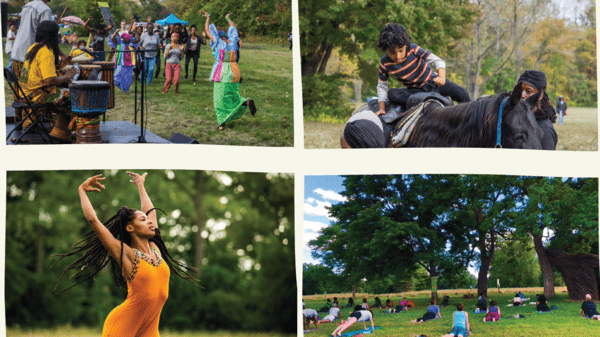
Throughout 2025-2026, interactive workshops, which included rain chain-building sessions and panel discussions, took place at our bi-annual Sidewalk Festival hosted at Eliza Howell Park in addition to off-site at our partner organizations. One resident shared with us their appreciation for explaining sewer infrastructure in plain language, acknowledging hardships, and showing compassion. With a permanent sculpture at the park and with activations happening year-round, residents have and will continue to gain generative learning opportunities around stormwater systems and climate justice, along with actionable strategies they can apply at home—such as rainwater mitigation techniques, flood prevention practices, and basic infrastructure literacy.
About Sidewalk Detroit
Sidewalk Detroit is a non-profit organisation working to celebrate the city's landscape and culture through socially relevant public art, community engagement and advocacy. You can find their website here and their Instagram page here.
Their key collaborators include artist Maya Davis (website, Instagram), Huron-Clinton Metroparks, the University of Michigan (Dow Sustainability Fellows Program), and the Gilbert Family Foundation.
Publishing date:
Related multimedia

The sole responsibility for the content of this website lies with the project and in no way reflects the views of the European Union.